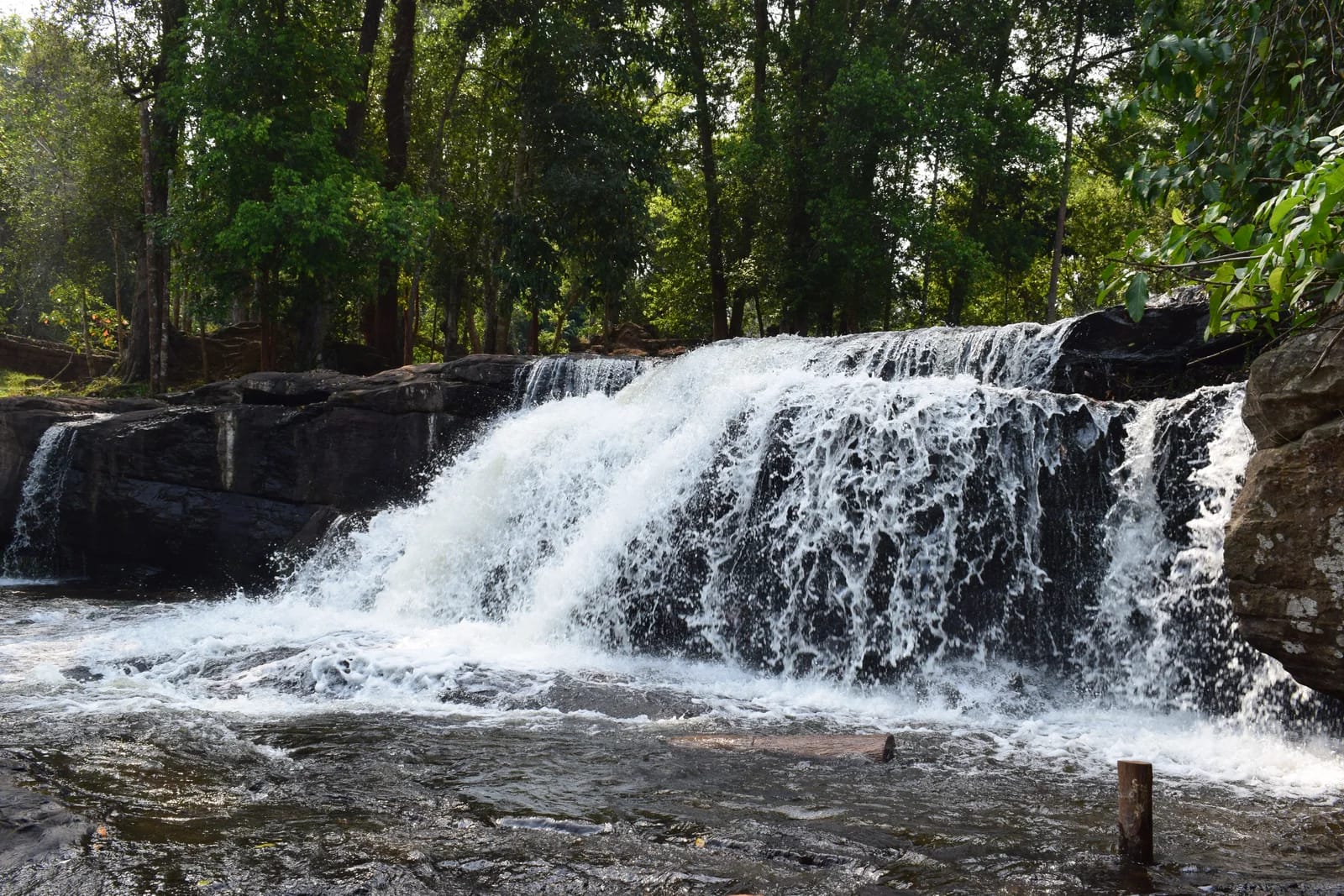
Redimensionnement, conversion WebP et cadrage d’affichage ; adaptation sous la même licence. / Resize, WebP conversion and display crop; adaptation under the same licence.
A day at Phnom Kulen — also written Koulen — takes you beyond Angkor’s temple circuits to a sacred mountain, a carved riverbed and a waterfall. Our advice: allow a full day, leave Siem Reap early and choose between the classic visits and a proper hiking day. Trying to fit in everything takes away much of the pleasure.
The essentials before you decide
Your question
The useful answer
How long do you need?
A full day; allow roughly 1½–2 hours’ driving each way, depending on your starting point and conditions.
Does the Angkor Pass cover it?
No. Kulen has a separate ticket: budget USD 20 per foreign visitor at the gate.
When should you leave?
We suggest 7:30–8am from Siem Reap, leaving a buffer before uphill access ends.
Car, minivan or tuk-tuk?
A car or minivan with a driver for the classic day. Do not book a basic tuk-tuk transfer assuming it will take you up to all the visits.
Is it suitable for children?
With a pace and stops that suit them. Swimming is optional; this is not a supervised pool.
Do you need a guide?
A guide adds context and helps organise the visits. Arrange a guided route if you want to explore beyond the developed visitor areas.
PhnomKulen.com describes ticketing and road access. SiemReap.net covers the journey and transport choices. A driver provides transport; a guide should be specified separately.
The Map · Koulen
Three stops on the plateau
A sacred mountain, a carved riverbed and a waterfall.
This is our suggested pace, not an official timetable or a fixed-price package. The order of the three visits can change with access, crowds and weather.
When
What we would plan
Why
7:30–8am
Leave Siem Reap with water, cash and suitable shoes
Avoid cutting uphill access too fine.
Morning
Ticket checkpoint, drive up and visit Preah Ang Thom
Allow time for steps and the place of worship.
Late morning
Stop at the plateau’s River of a Thousand Lingas
Look at the carvings without walking over them.
Lunch
A proper break, arranged with your driver
Keep the day from becoming a dash between stops.
Early afternoon
Waterfall, a walk and optional swimming
Enjoy the setting without needing to enter the water.
Afternoon
Return within the downhill window confirmed locally
Keep your hotel arrival time flexible.
Road access is the detail to settle before leaving. Published information gives an uphill cutoff of either 11am or 11:30am. Do not plan around the last possible entry: ask your driver to confirm that day’s uphill and downhill windows.
Three stops with different reasons to visit
Preah Ang Thom is a pilgrimage site with a large reclining Buddha. Wear clothes covering shoulders and knees and remove shoes where requested. Give worshippers room; this is more than a photographic backdrop.
The plateau’s River of a Thousand Lingas rewards a closer look at carvings in the riverbed. Their visibility depends partly on the water level. Be careful with itineraries found online: Kbal Spean and the plateau’s carved river are different stops. Ask for the exact names so you do not book a different excursion from the one you imagined.
The waterfall deserves time even without a swim. Access includes steps and the surrounding surfaces can be slippery. With children, plan for an adult to stay with anyone who does not want to descend or enter the water. Swimming should not determine whether the day is a success.
The Archaeology and Development Foundation, which works on the mountain, distinguishes the plateau sites from Kbal Spean and explains Kulen’s religious and archaeological importance. Mahendraparvata was an early Angkorian capital: a guide’s explanation can change how you read the landscape.
Save the landmarks
These map searches help you recognise the places; confirm road access with your driver rather than relying on automatic routing.
Admission and transport are separate costs. At USD 20 each, entry for two foreign visitors is USD 40; for four it is USD 80. This excludes a driver, guide and meals. Check any child exemptions and required identification before working out a family total.
To compare two offers, ask for the same details:
a vehicle for your group, hotel pickup and return;
whether admission is included or paid separately;
whether there is a guide, and in which language, as distinct from a driver;
the three planned stops, meals and any additional charges;
what happens if weather or access requires a change of plan.
Shoes that stay securely on your feet, water, some cash, sun protection, appropriate temple clothing and, if wanted, a towel and a change of clothes. Save your driver’s contact details before leaving.
At the waterfall, assess the flow and follow local instructions. Do not jump from rocks, approach an edge for a photo or assume a particular water depth. If conditions do not suit you, enjoy the site on foot. Stay on established paths or the route your guide follows.
Classic visits or a hiking day?
For a first visit, we would choose the three classic stops. If you want more walking, book a day designed around that: duration, difficulty, guide, transport and meals need to be agreed together. ADF presents community-based tourism options on the mountain; these require separate arrangements from the basic entry ticket.
Our recommendation is to choose a day that works as a whole, rather than adding a long trek to an already full excursion. Apply the same thinking to Angkor: compare our one-, two- and three-day temple guide. Travelling with children? Our Siem Reap family activity guide helps you balance the days.