Les sites cambodgiens inscrits au patrimoine mondial de l’UNESCO : que voir sur place ?
Les cinq biens cambodgiens inscrits au patrimoine mondial de l’UNESCO, d’Angkor et Koh Ker aux sites mémoriels, avec des repères pour préparer une visite éclairée.
Cambodia has five properties on the UNESCO World Heritage List: Angkor, the Temple of Preah Vihear, Sambor Prei Kuk, Koh Ker and the Cambodian Memorial Sites. The temple journey below keeps Angkor Wat and Banteay Srei as separate stops to help you plan, although both belong to the single Angkor inscription. The memorial sites, added in 2025, bring a different and important chapter of Cambodian history into the picture.
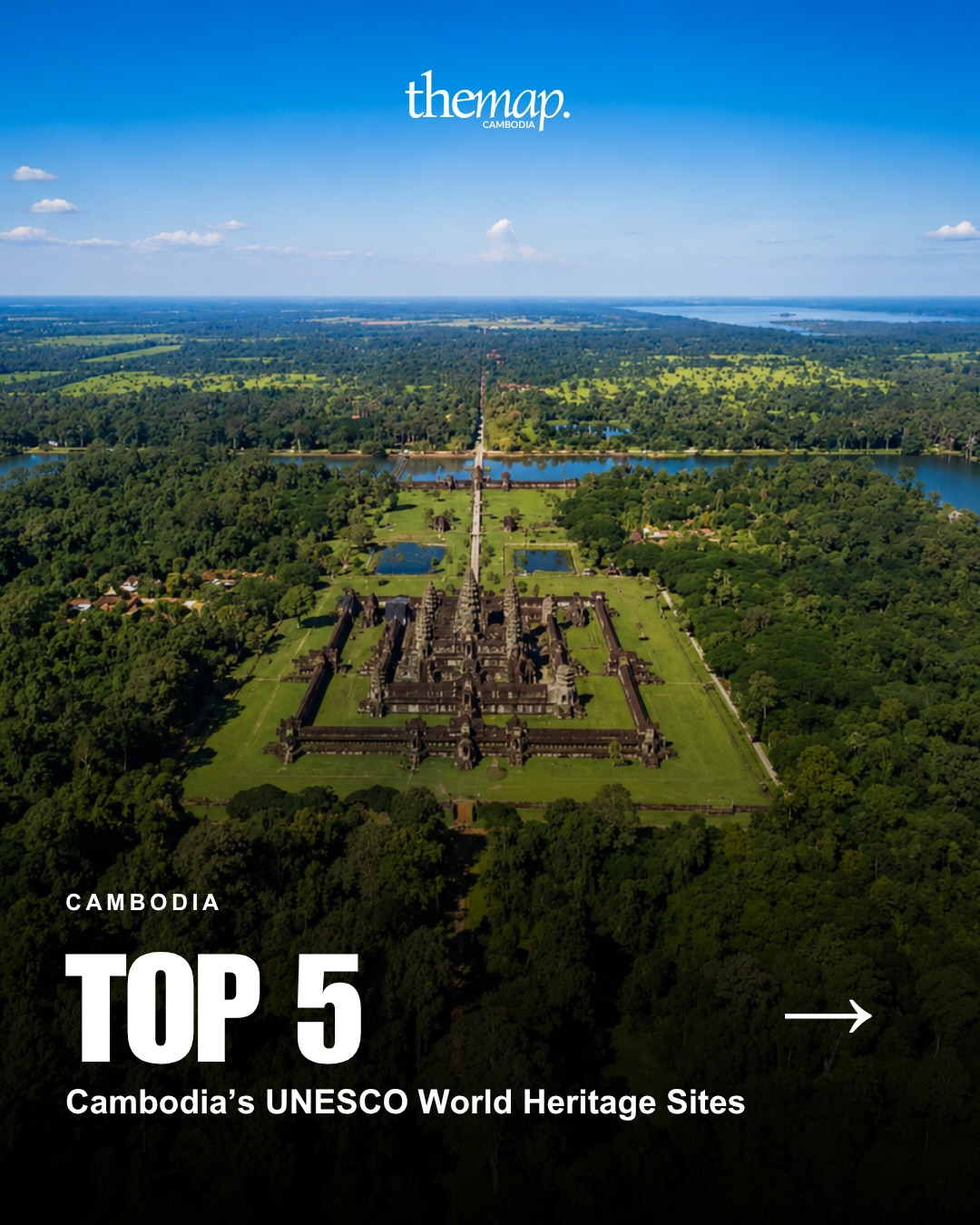
Angkor Wat and its moat seen from the air, surrounded by forest and water
1. Angkor Wat, the monumental heart of the empire
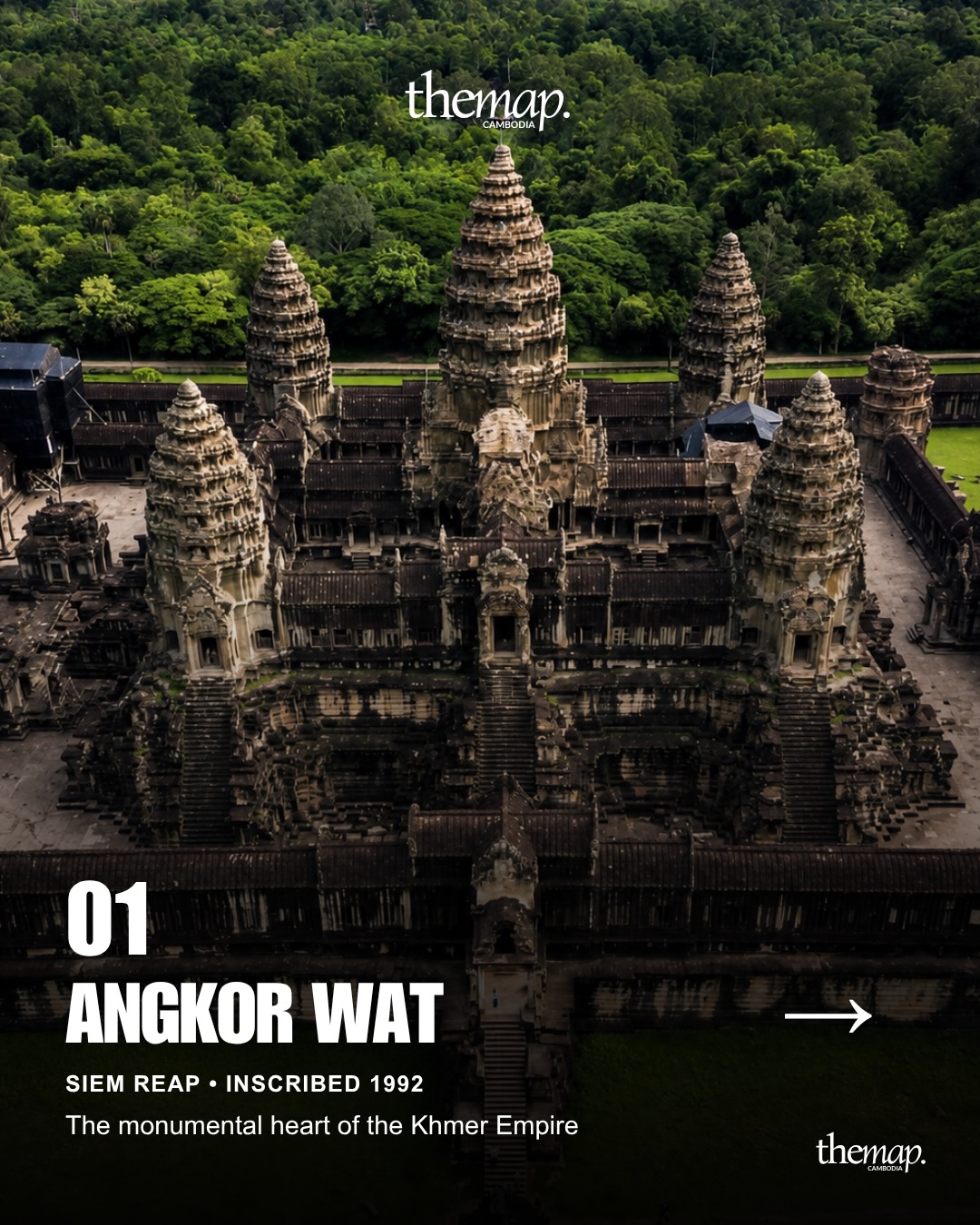
Angkor Wat is the largest religious monument in the world, built in the early 12th century under King Suryavarman II and dedicated first to the Hindu god Vishnu before becoming a Buddhist temple. Seen from the air, the towers rise in a tight cluster above the galleries, with the forest starting immediately behind the outer wall. The wider Angkor site was inscribed in 1992.
Aerial view of the towers and galleries of Angkor Wat with forest behind
2. Banteay Srei, the carvings
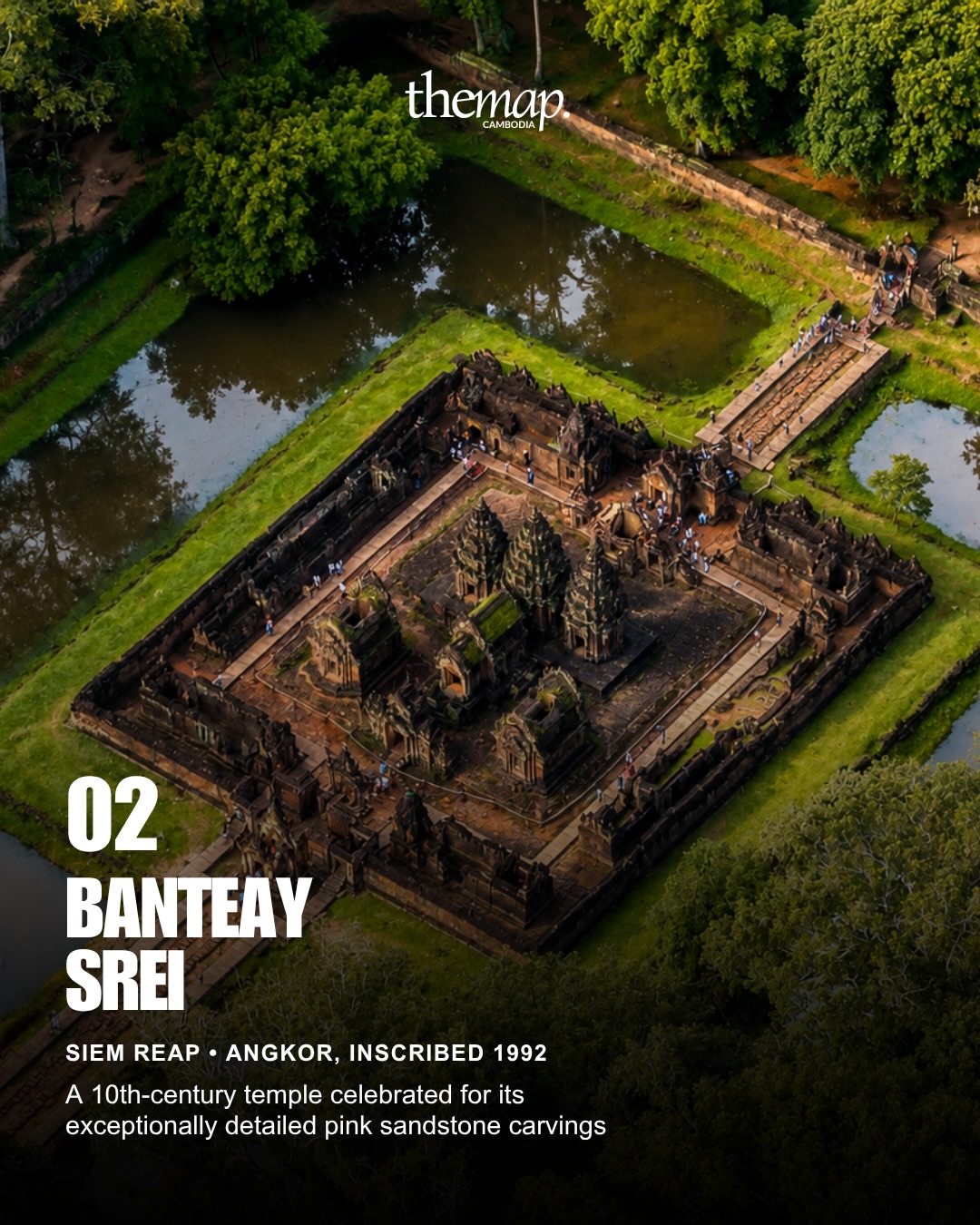
Banteay Srei is a 10th-century temple dedicated to Shiva, and unusual in that it was commissioned by royal officials rather than by a king. It is small, and it is known for the density of its pink sandstone carving — the reason it is often called the jewel of Angkor. From above you can see how compact it is: a moated rectangle with a short causeway in. It falls under the 1992 Angkor inscription.
Aerial view of the moated rectangular enclosure of Banteay Srei
3. Sambor Prei Kuk, the pre-Angkorian capital
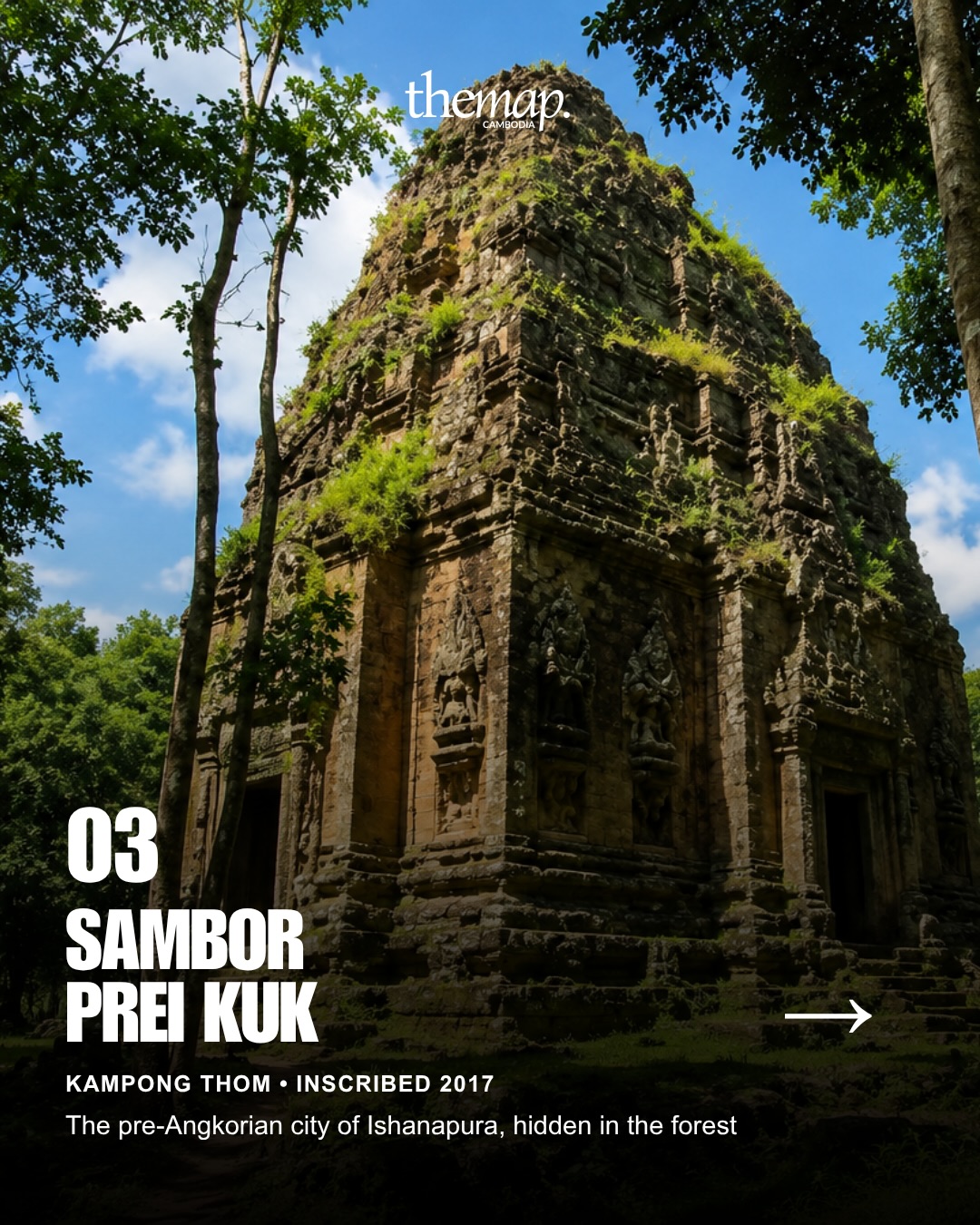
Once known as Isanapura, Sambor Prei Kuk in Kampong Thom was a 7th-century capital and holds some of the earliest surviving temples in Cambodia, including distinctive octagonal towers. The brick still carries carved figures in its niches, with vegetation growing out of the upper courses. Inscribed in 2017.
A brick tower of Sambor Prei Kuk with carved niches and vegetation on its upper courses
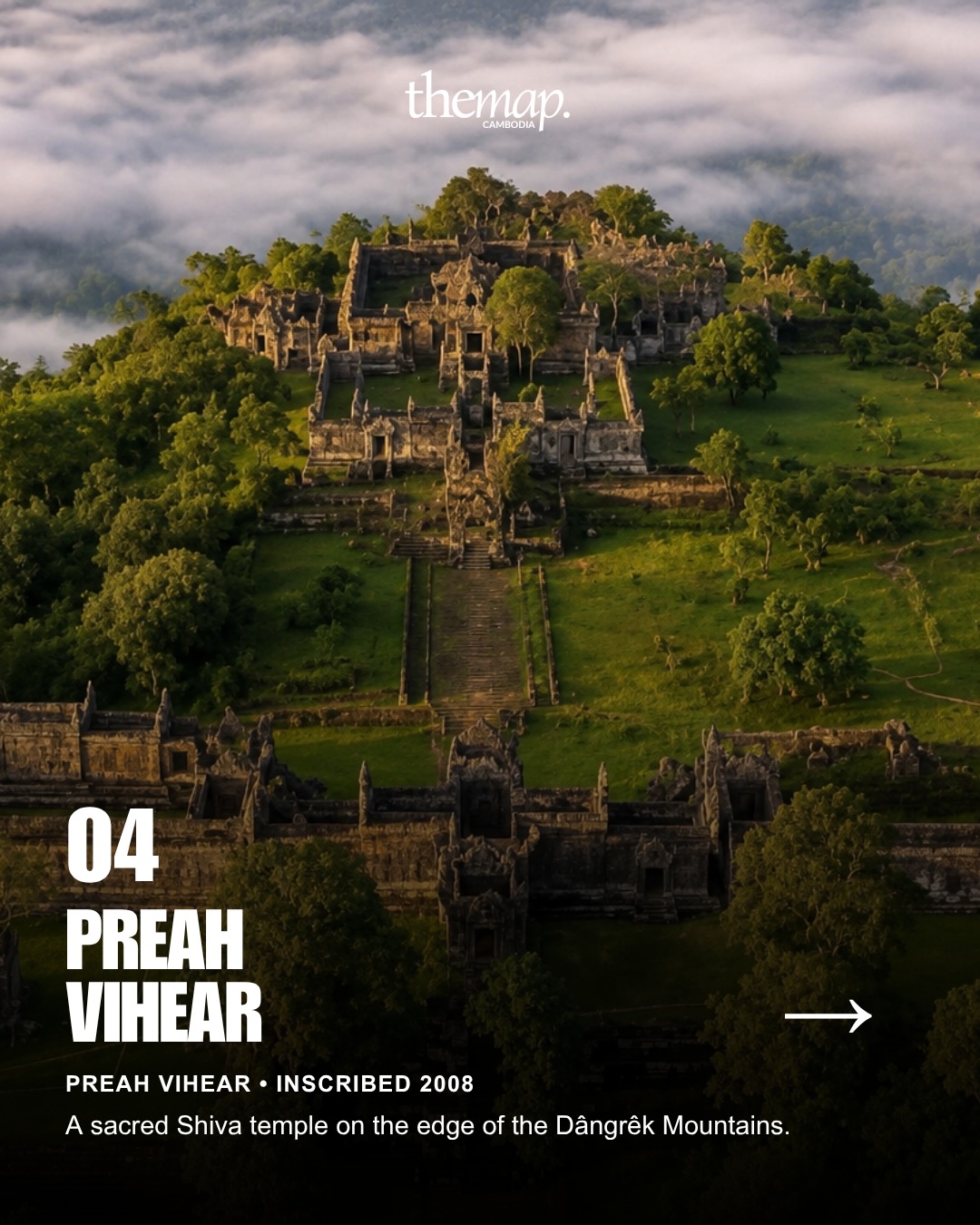
4. Preah Vihear, on the escarpment
Built between the 9th and 12th centuries, Preah Vihear is a Shiva sanctuary laid out along a dramatic axis some 800 metres long, climbing the edge of the Dângrêk Mountains. The photograph catches it at dawn with cloud sitting below the escarpment — successive courtyards and stairways stepping up the ridge. Inscribed in 2008.
Preah Vihear temple at dawn, its stairways climbing the ridge above a layer of cloud
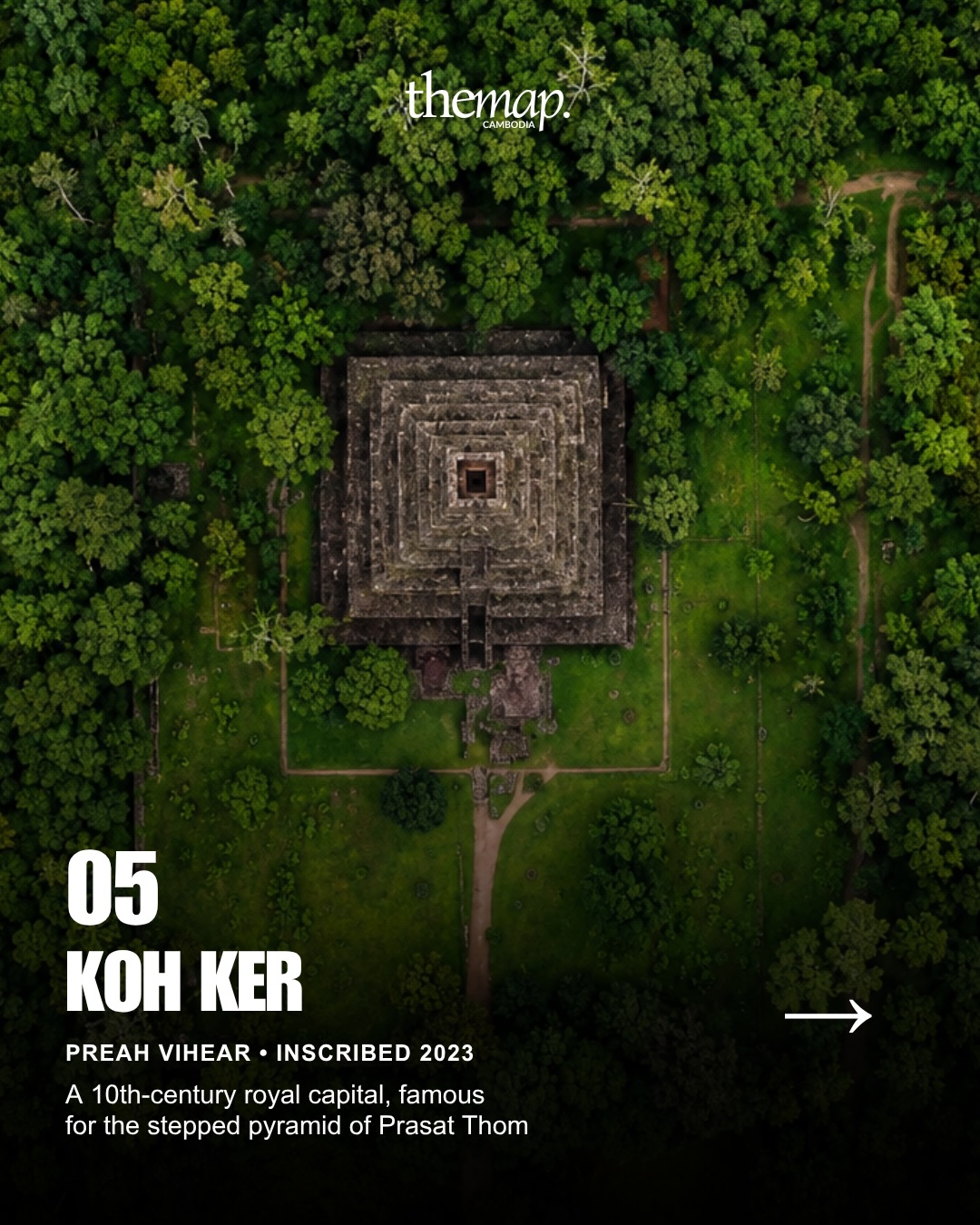
5. Koh Ker, the capital that lasted twenty years
After a disputed royal succession, King Jayavarman IV left Angkor and established a new Khmer capital at Koh Ker in 928 AD, where he built the stepped pyramid of Prasat Thom. From directly above, the pyramid reads as a set of concentric squares in a clearing, with forest closing in on every side. Koh Ker was inscribed in 2023.
Overhead view of the stepped pyramid of Prasat Thom at Koh Ker, surrounded by forest
6. Cambodian Memorial Sites, places of remembrance
Inscribed in 2025, the Cambodian Memorial Sites form one UNESCO property across three locations: the former M-13 prison, Tuol Sleng Genocide Museum and Choeung Ek Genocidal Center. They preserve evidence of Khmer Rouge repression and honour its victims.
Tuol Sleng and Choeung Ek offer essential context for understanding modern Cambodia. Give these visits time and space in your day, and approach them as places of remembrance. UNESCO describes M-13 as not currently accessible to visitors; it should not be treated as another routine stop on the same itinerary.
Planning around them
Angkor Wat and Banteay Srei are both within reach of Siem Reap and are usually done over two or three days on the same pass. Sambor Prei Kuk sits off the road between Siem Reap and Phnom Penh, which makes it easy to fold into a transfer. Preah Vihear and Koh Ker are further north and generally need their own day, often combined.
The five inscriptions and their dates follow the UNESCO list for Cambodia, checked on 2 September 2026. Banteay Srei remains part of Angkor, not a separate inscription.
Passez de l’inspiration au terrain
Continuez avec les guides utiles.
Approfondissez les étapes qui vous intéressent. Pour l’ordre précis, les bonnes durées et la coordination, nous construisons ensuite le voyage autour de vos dates.